
Choking First Aid: Complete Guide for All Ages
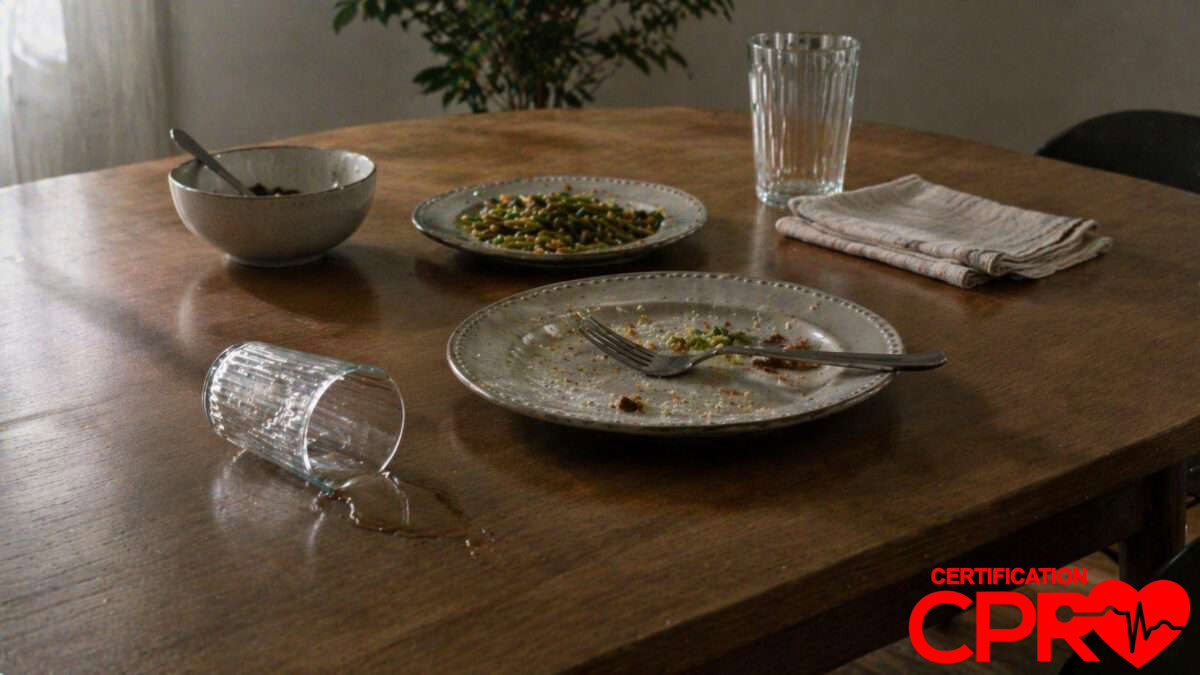
The table had been loud for most of dinner, a birthday party, eight people, a lot of laughing. Then one corner of it went quiet. A woman in her fifties was sitting very still, one hand at her throat, her face going red. She wasn’t coughing. She wasn’t speaking. The man next to her asked if she was okay and got nothing back. That silence, ten seconds into what had been a normal meal, was the moment it became a choking emergency.
Choking is one of those emergencies that moves faster than people expect. The first job is not recalling every term from a safety course. It is figuring out whether air is still moving. If the person can cough forcefully, speak, or answer you, stay close, encourage coughing, and be ready to act if things get worse. If they cannot speak, cannot breathe, or are only making weak and silent attempts to cough, that is a severe blockage, and the response starts immediately.
How you respond changes with the person’s age and size, and with whether they are still conscious. Adult, child, and infant choking are not handled the same way. The technique feels much more natural after hands-on practice than it does in the middle of a real scene, and that gap between reading and doing is exactly why training exists.
Educational note: use this information for general awareness only. It is not a substitute for calling 911, hands-on training, or professional medical judgment during an emergency.
Upcoming CPR Class Dates and Times
Recognizing Severe Choking
The difference between mild and severe choking is the difference between someone who needs encouragement and someone who needs immediate help. A person with a mild blockage can still cough with real force and move some air. That coughing is the body doing its own work, and the right call is to stay with them and let it. A person with a severe blockage cannot speak, cannot move air effectively, and may not be able to cough at all, or may only produce a weak, nearly silent effort. The look on their face tends to make the situation clear: they are panicking, hands moving toward the throat, eyes wide, and nothing is coming in or going out.
What looks like ordinary choking after food “went down the wrong pipe” is usually a mild blockage that clears on its own. Severe choking is different in every visible way, the person’s color changes, they cannot communicate, and any delay in the response makes a bad situation worse. Once you’ve seen that distinction, you do not forget it.
Helping a Choking Adult or Child
For a conscious adult who cannot speak, breathe, or cough effectively, send someone to call 911, or call yourself if you are alone, and start the choking-relief sequence without wasting time. The combination of back blows and abdominal thrusts is designed to create repeated bursts of pressure in the airway. Neither technique alone is the full response. Both are needed, alternating, until the object clears or the person loses consciousness.
Position yourself behind the person and brace them, one foot slightly between theirs gives you stability and gives them support. Lean them forward slightly if you can. Give five firm back blows between the shoulder blades using the heel of your hand. Each blow should be deliberate, not a random swat. Then wrap your arms around the waist, make a fist with one hand, and place the thumb side just above the navel and well below the breastbone. Cover that fist with your other hand, and give five quick inward-and-upward thrusts, sharp, controlled pulls, not slow squeezes. Keep alternating five back blows and five abdominal thrusts until the object comes out or the person goes unresponsive.
A choking child between roughly one and eight years old follows the same pattern, five back blows, five abdominal thrusts, but the force has to be scaled to the child’s size. You are still trying to dislodge an obstruction from the airway, but adult strength on a small body causes its own harm. The sequence is the same; the calibration is different. With children, panic raises the stakes in both directions: rescuers either freeze or overdo the force, and neither outcome helps the child in front of them.
The word “Heimlich” still comes up in everyday conversation, and that is fine. In formal training language, you are performing abdominal thrusts as part of the conscious choking response. The technique is the same regardless of what you call it. The AHA BLS CPR class covers choking relief as a core hands-on skill, not a footnote.
Infant Choking: A Different Technique
Infant choking is its own emergency and should not be treated as a scaled-down version of adult choking. Abdominal thrusts are not used on infants. The technique changes entirely, and knowing that distinction in advance, not in the middle of the emergency, is what makes the response work.
If an infant cannot cry, cough, or breathe normally, call 911 immediately or direct someone nearby to do it. Place the infant face-down along your forearm with the head lower than the chest, supporting the head and jaw firmly. Give five back blows between the shoulder blades using the heel of your hand, firm, but controlled for the size of the infant. If the object does not clear, carefully turn the infant face-up along your other forearm while keeping the head lower than the chest. Place two fingers in the center of the chest just below the nipple line and give five chest thrusts, not abdominal thrusts. Keep alternating five back blows and five chest thrusts until the airway clears or the infant becomes unresponsive.
The physical reality of holding a choking infant, the weight, the angle, the fear, is something that reading about does not fully prepare you for. Parents, babysitters, grandparents, and anyone responsible for infants regularly should practice this in a class environment. The CPR and First Aid class builds infant and child choking relief into broader emergency training, and that practice is what makes the skill accessible when it has to be.
Special Situations: Pregnancy, Obesity, and Choking Alone
For a visibly pregnant person, or for anyone whose body size or shape makes abdominal thrusts impossible to perform safely, chest thrusts replace abdominal thrusts entirely. The hand position shifts to the center of the chest, the same general area used for CPR compressions, and the motion is a sharp inward thrust rather than the inward-and-upward pull used on the abdomen. The back blows remain the same. This is not a workaround; it is the correct technique for this patient population, and it works through the same pressure mechanism.
If you are choking and no one is nearby, call 911 first if you can get any words out. Then make a fist, place it above your navel and below your breastbone, cover it with your other hand, and thrust inward and upward as firmly as you can. If that does not dislodge the object, find a hard edge, a countertop, a sturdy chair back, a railing, and drive your upper abdomen against it with as much force as you can manage. The goal is the same forceful inward-and-upward pressure that a rescuer behind you would create. It is harder to generate alone, which is why calling 911 first matters: dispatchers can stay on the line and direct EMS to you even if you lose consciousness.
Prevention also belongs in this conversation. For parents and caregivers, cutting food into age-appropriate pieces and enforcing sitting-down meals reduces the risk significantly. Small objects, button batteries, coins, loose toy parts, belong nowhere near infants and toddlers. Children should not run, laugh hard, or play while eating. For restaurants and food-service teams, knowing who calls 911, where the phone is, and who steps in when a customer chokes is something that should be decided before a dining room emergency, not during one. High-traffic venues and busy event spaces benefit especially from staff with hands-on training rather than a posted policy.
When the Person Becomes Unresponsive
Upcoming CPR Class Dates and Times
If the choking response does not clear the airway and the person loses consciousness, lower them carefully to the ground, call 911 if that has not already happened, and begin CPR. Start chest compressions. Each time you open the airway before giving breaths, look into the mouth, but only act on what you can actually see. If the object is visible, you can try to remove it. If you cannot see it clearly, do not do a blind finger sweep. Reaching in without visibility can push the object deeper.
A choking emergency that has turned into unresponsiveness is now also a potential cardiac arrest. The two emergencies overlap at that point, and the response includes CPR, an AED if available, and 911 on the line. A person who was choking and collapses is different from someone who collapses without warning from cardiac arrest, but from that moment forward the treatment follows the same emergency path. For a broader look at how the two emergencies compare and how CPR fits into the larger response, the first aid basics guide connects this to the wider emergency picture.